
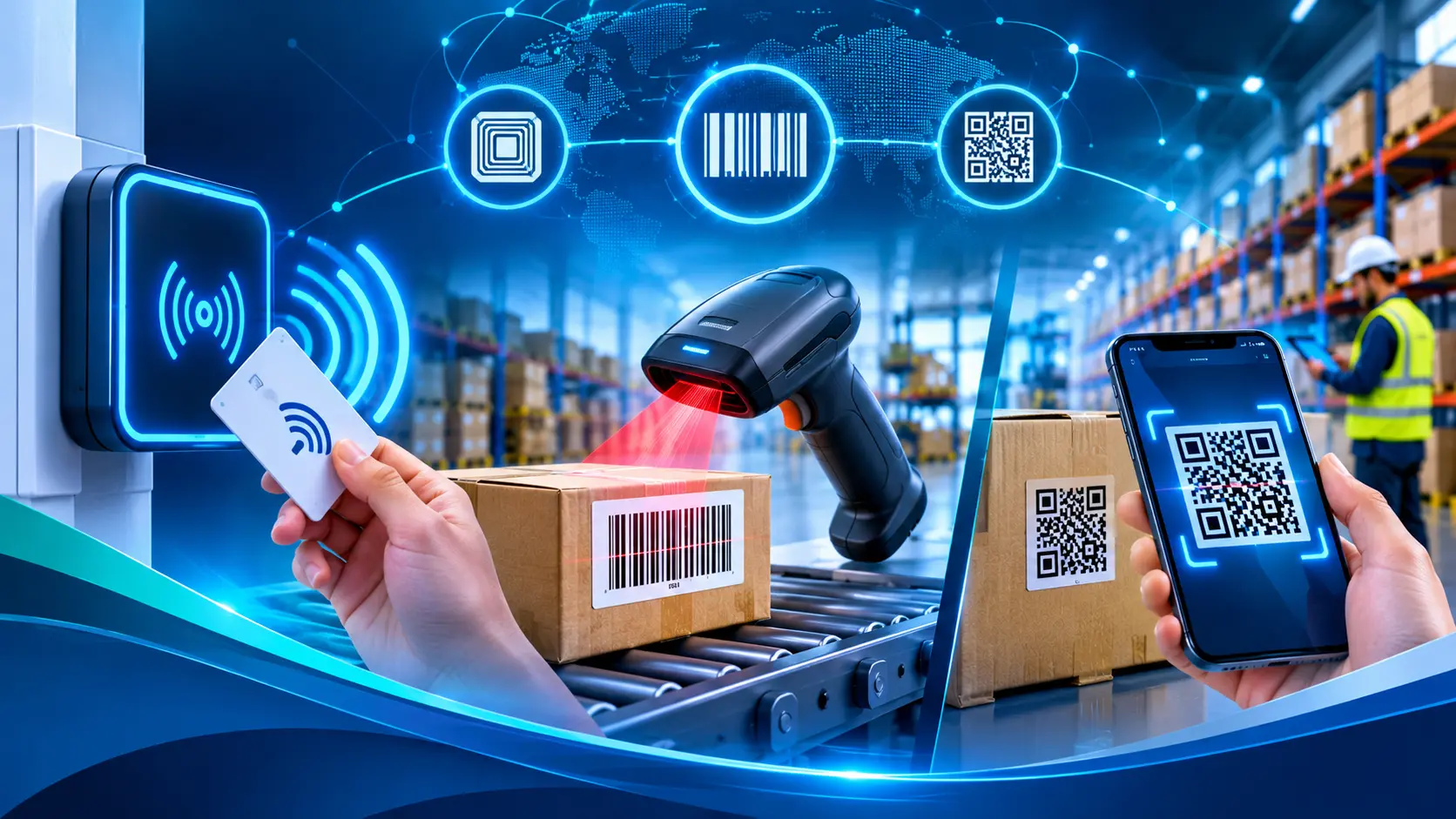
Businesses use different technologies to identify and track their assets: barcode labels on laptops, QR codes on maintenance equipment and RFID tags in warehouses. But each one works in a different way and has its own good and bad points. When you compare RFID vs barcode vs QR code for asset tracking, the right choice depends on many things, such as how many assets the business is having, how often an audit is done, how much visibility is needed and what the budget is.
For example a small office with a few hundred laptops, barcodes or QR may be enough. A warehouse that needs to identify many tagged items during frequent inventory checks, we can look at RFID. If you understand how these work, it is easy to choose the method and keep the records more reliable.
Barcode, QR code and RFID are all used to identify the asset and connect it with the record. The main difference is how each one tells the asset identity to the tracking system.
Barcode uses an optical pattern and a scanner reads it. QR code is also a type of barcode, two-dimensional , scan with smartphone or scanner. RFID is using radio frequency between tag and reader.
| Feature | Barcode | QR Code | RFID |
|---|---|---|---|
| How identified | Optical scanning | Optical scanning | Radio frequency |
| Line of sight | Usually need | Usually need | Not always need |
| Equipment | Barcode scanner | Smartphone or scanner | Reader and antenna |
| Many items | Scan one by one | Scan one by one | Many tags may read together |
| Data capacity | Limited for 1D | More than 1D barcode | Depend on tag type |
| Cost | Labels, scanner, software, labor | Labels, device, software, labor | Tags, readers, antenna, software, setup |
| Common use | Inventory, equipment audit | Asset ID, digital record access | High volume verification |
Each can support asset tracking but which one is suitable depends on how the business identifies assets, update records and do physical verification.
Barcode asset tracking uses printed labels with machine-readable patterns to identify each asset. Every barcode is linked with one asset record in the system. Businesses can use it for laptops, office furniture, tools, machinery and inventory items.
For example, the IT department attaches barcode labels on company laptops. In quarterly audits, employees scan the labels and compare with the company records. This helps the organization to know which assets are present and which records need investigation.
Barcodes also have some limitations.
Barcode may suit business with a moderate number of assets and periodic physical audit. An office that verifies laptops, printers, monitors every quarter may find it practical when scanning effort is manageable. But if the organization needs to identify many items quickly or reduce manual scanning, they should also see QR and RFID.
QR code asset tracking uses two-dimensional barcodes to identify physical assets and connect to digital information. QR can keep asset ID, text or URL. When code has a URL that opens the asset record, authorized users can open it with their smartphone. So it is useful when businesses want easy access to asset information without special barcode hardware.
A maintenance technician checking industrial equipment can scan the QR and see identification details and maintenance history, if those details are available in the connected system. QR gives the link or ID, the software decides what the user can see and what updates can be recorded.
Businesses should also think about label durability, smartphone compatibility, network access where required and how employees will update the records.
QR suits organizations that want convenient identification and digital record access by smartphone. A maintenance team can scan QR on a machine and get its record before inspection. It also works well for office equipment and assets identified during periodic verification. But for automated identification of many items, RFID may be worth evaluating.
RFID stands for Radio Frequency Identification. It uses radio frequency communication to identify tagged objects with RFID readers. A system normally has tags, readers, antennas and software that process the data.
Unlike barcode and QR, RFID does not necessarily need the tag to be directly and visible to the reader. Depending on technology and environment, the reader may identify many tags within its reading zone. It is used in inventory verification, warehouse operations, equipment identification and other workflow where automated or high volume identification is useful.
A warehouse may use RFID readers to identify many tagged items in inventory verification, then the system compares detected IDs with expected inventory records. Actual performance depends on tags, readers, antenna configuration, materials and surrounding environment.
RFID systems are different by power source and operating frequency.
These are not interchangeable in every situation, so business should check actual operating requirements before choosing the configuration.
RFID also has challenges.
RFID systems must be configured and tested in actual operating condition to know the performance.
RFID is worth evaluating when organizations need frequent identification of many assets, want to reduce manual scanning or need automated identification at selected locations. Warehouses that verify large quantities of tagged items in regular inventory may benefit if reading performance and total cost meet the requirement. But RFID is not automatically best for every business, for smaller asset collection or occasional audit, barcode or QR may give better balance of cost and function.
Understanding how each works is only the first step. Businesses must also compare cost, operating requirement, performance and suitability for existing processes.
Barcode and QR labels are generally cheap to produce, attractive when organizations can use existing devices or affordable scanners.
RFID can have additional cost for tags, readers, antennas, installation, integration and testing. But label or tag price alone does not decide the most economical solution.
A company doing an occasional audit may find QR enough. Another company with frequent high volume verification may find RFID reduction in manual scanning needs more evaluation. The right comparison is total cost over the intended period , not only price of one label or tag.
Barcode and QR usually scan individual visible labels, the time depends on the number of assets, label accessibility, equipment and staff workflow.
RFID may identify many tags in the reading zone so manual effort can be reduced in a suitable environment, but differences depend on system configuration and how assets are arranged. Businesses should test representative assets and compare time of actual audit before selecting.
Barcode and QR need labels visible and positioned so the scanner or camera can read. RFID can identify without direct visual access, depending on tag, frequency, reader setup and environment.
It does not mean RFID can read every tag through every material or from any distance, practical range must be checked in intended condition.
Traditional 1D barcodes encode a small amount of information, while QR code can encode more. RFID tags have different storage depending on their design and type.
But in asset tracking the technology does not need to contain every detail, a unique ID can be used to get a centralized record with description, assigned employee, location, maintenance history and other information. This keeps records manageable and the organization can update information without reprint identifiers when assets change location or owner.
Durability of barcode and QR labels depend on material, printing quality, placement and environment. RFID tags also vary. For example metal surfaces can affect certain RFID tags unless designed for it.
Printed labels may need suitable material for heat, moisture, abrasion or cleaning. So choose an identifier made for actual working conditions and test before deployment.
No identification method gives a perfect result in every condition. Barcode and QR can fail if the label is damaged, covered or poorly positioned. RFID may miss tags or give unwanted reads depending on reader configuration, tag orientation and environment.
Reliable tracking also depends on accurate records, so organizations should set procedures for unique IDs, transfers, verifying details and investigating discrepancies, whatever technology is used.
Technology should work with the organization asset management process. A suitable system should link identifiers to asset records and, where supported, manage assignment, location updates, physical verification and reporting.
Before implementation check compatibility with existing asset software, ERP, scanning devices and workflows. What works for a small team may need different infrastructure when deployed in multiple sites, so planning scalability avoids rework when asset collection grows.
Most suitable one depend on assets managed, how often they move and how organizations do verification.
Laptops, monitors, printers, furniture and other equipment given to employees or departments. Barcode or QR may be enough when employees can scan visible labels in scheduled audits or transfer. Choice between them depends on scanning preference, existing equipment and how users access records.
Tools, equipment, components and other assets across production and storage. Barcode and QR support identification and record access, RFID may be worth evaluating where frequent verification or automated identification is needed. The operating environment is very important when selecting labels or tags for machinery and production areas.
Large quantity of inventory, tools and equipment. Barcode suit workflow where workers scan items in picking, receiving or verification. RFID may be useful when many tagged items need to be identified within the reading zone, but benefits depend on inventory process, tag placement, reader configuration and cost.
Medical equipment, portable devices, furniture across departments. Barcode and QR support equipment identification and record access, RFID may be evaluated for automated identification or frequent equipment verification. Select according to workflow, environment, equipment compatibility and visibility requirements.
Organizations managing multiple offices, branches, or warehouses can organize assets zone-wise, floor-wise, department-wise, or location-wise. Barcode, QR code and RFID helps identify assets, while centralized software maintains asset records, tracks movements and supports consistent management across locations.
Choosing begins with understanding the actual requirement of the organization not selecting a solution only by its features.
List categories, locations and how they are used. Laptops and office furniture may have different needs from production equipment or assets moving in a warehouse.
For occasional audit of manageable numbers, barcode or QR may be sufficient. For frequent high volume identification, RFID is worth testing.
Decide if you need simple identification, periodic verification, movement history or automated detection at specific points. Don’t assume identification technology automatically gives continuous location tracking, that depends on the wider system and infrastructure.
Think about label visibility, surface material, temperature, moisture, cleaning and possible interference. Test the labels or tags on representative assets in the actual working place.
Compare labels or tags, hardware, software, installation, employee time, maintenance and replacement. Low cost labels may need more manual work, expensive systems may give automation, decide whether the difference creates enough value.
Confirm the technology works with your software, scanners, readers and process. Check how identifiers map to asset records and how changes of assignment or location are recorded.
Do a pilot with a representative group of assets. Measure scanning effort, read reliability, ease of use, record accuracy and operating requirement, then decide to proceed, adjust or evaluate other technology.
RFID, barcode and QR code, all three have different ways to identify the physical assets. Barcodes may suit simple scan based audits, QR codes give easy access to digital records with a smartphone, and RFID is good when you need automated identification for many items. The right choice depends on your assets, how often an audit is done, the environment and the total cost and no one technology is best for every business.
Before you choose, check your current tracking process and test the options with few assets in real working condition. If you are looking for asset tracking software, you can see Agaram InfoTech solutions and confirm which methods and features fit your requirement, because the goal is not only to identify an asset, it is to keep the records reliable.
RFID is better for many assets and frequent checks, barcode is better for small business or periodic audit, because RFID reader can read many tags in reading zone, no need to see each label, but barcode need visible label and we scan one by one, though it is cheap and fine for scheduled audit
QR code is better for quick access to digital records, because QR can hold more data than a normal 1D barcode and with a smartphone you scan it and the asset record opens directly, but a barcode is enough if only identification is needed.
Yes, most smartphones can scan QR code and many can scan common 1D barcodes also with suitable apps, but support depends on device, camera and app, so test on a few assets first, then we can use it for all.
No, RFID does not need direct line of sight between tag and reader, but metal, liquid and other obstacles can affect result, so you should test in the real place where it will be used.
No, RFID alone does not give an exact real-time location, because readers only detect the tag in its reading zone or at a checkpoint, so for real-time location they need extra technology like RTLS.
Barcode and QR labels are cheapest to start, but complete costs include software, scanners , employee time and maintenance and RFID needs extra infrastructure, still it can reduce manual scanning in the right use case.
Yes, QR for some assets and RFID for others, it works when every identifier is mapped to correct asset record and software support both, so organization no need to force everything to one technology.
For simple use no, basic QR can show stored information without software, but for managing assets yes, because assignment, movement history, audit and reports need proper asset management software and RFID also need compatible readers.
First define what you need, then compare barcode, QR and RFID against it, set the same asset ID format and one standard procedure for assignment and movement and compare options on environment, software compatibility, scalability and total cost.

Working on enterprise application development and technology-driven business solutions, focusing on full-stack .NET engineering, AIDC integration, system architecture and operational automation.
LinkedIn sarathkumar.b@agaraminfotech.comTalk to Agaram Infotech about RFID, QR and barcode tracking built around your process.
Contact us