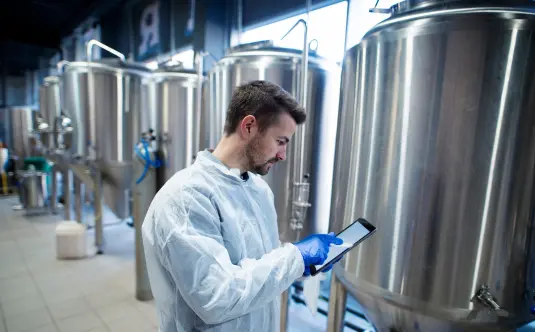
The brewing industry has evolved far beyond traditional production
methods. Modern breweries are now
expected to maintain consistent quality, manage inventory efficiently, comply with strict
regulations and
meet growing customer demand—all while keeping operational costs under control.
As breweries expand production and distribution, managing operations
manually becomes increasingly
difficult. Spreadsheets, disconnected systems and paper-based tracking often lead to inventory
mismatches, production delays, compliance risks and poor visibility across departments.
This is where Brewery Management Software becomes essential.
A Brewery Management System helps breweries streamline operations by integrating production,
inventory, sales, procurement, quality control and reporting into one centralized platform.
Instead of
relying on fragmented processes, breweries gain complete visibility and control over every stage
of
operations.
1. How Does Brewery Management Software Improve Operational Visibility?
In many breweries, operational data is spread across multiple
departments. Production teams maintain
brewing records, inventory teams track raw materials separately and finance teams manage costing
independently.
On paper, operations may appear organized. In reality, there is often no
single source of truth.
A Brewery Management System centralizes all brewery operations into one platform, enabling :
The Shift from Manual Operations to Centralized Control
Production teams track batches separately
Inventory teams manage stock independently
Sales and finance use disconnected records
Without integration, delays and inaccuracies become common. Brewery
Management Software
eliminates this fragmentation by connecting every operational process in one system.
What this means for breweries
Real-time production visibility
Centralized inventory management
Improved coordination across departments
Accurate operational data for decision-making
2. Is Inventory Tracking Enough for Brewery Control?
Breweries operate in highly dynamic environments where raw materials,
packaging supplies and finished
goods constantly move between production, storage and distribution.
Tracking inventory alone is not enough. The real value lies in
answering critical operational questions instantly :
How much raw material is currently available ?
Which batch is in production right now ?
What is the production yield for each brew ?
Which products are nearing expiry ?
Why are stock shortages occurring despite available inventory ?
What is the actual production cost per batch ?
Without a proper system, finding these answers can take hours—or may
not be possible at all. With
Brewery Management Software, this information becomes available in real time.
3. What Changes After Implementing Brewery Management Software?
The transformation is operational, measurable and highly scalable.
Before Implementation
Is the asset currently in use or idle ?
Who is responsible for it at this moment ?
Has it moved through an authorized workflow ?
Is it due for maintenance or inspection ?
These transforms tracking into actionable intelligence, enabling
organizations to make informed operational decisions without delay.
After Implementation
Real-time inventory updates
Centralized production records
Accurate procurement planning
Cost tracking for every brew cycle
Quick compliance and audit reporting
With integrated barcode or RFID tracking
Raw materials can be tracked accurately
Finished goods movement becomes transparent
Manual entry errors are reduced
Stock audits become faster and more reliable
4. How Does Brewery Management Software Reduce Operational Risks?
Many breweries depend heavily on manual processes and individual
knowledge to manage production
and inventory. This creates significant operational risk.
When key personnel are unavailable, critical operational knowledge may
not be accessible. Errors in
inventory, production scheduling or compliance reporting can directly impact profitability and
product
quality.
A Brewery Management System reduces these risks by
Centralizing operational data
Maintaining complete batch history
Automating production workflows
Providing controlled multi-user access
Improving traceability across operations
This creates consistency, accountability and operational stability.
5. What Are the Financial and Operational Benefits of Brewery Management Software?
Brewery operations involve significant costs related to raw materials,
production, packaging, storage and
distribution. Poor visibility often leads to unnecessary losses.
Without Proper Brewery Control
Raw material wastage increases
Overproduction or underproduction occurs
Inventory losses impact profitability
Procurement decisions become inaccurate
Compliance risks increase operational costs
With Brewery Management Software
Optimized inventory utilization
Reduced production wastage
Better production planning
Improved financial forecasting
Data-driven procurement decisions
The software also improves predictability by reducing
Operational inefficiencies
6. How Does Brewery Management Software Improve Quality Control and Compliance?
Consistency is critical in brewing. Even minor variations in
ingredients, fermentation or production
processes can impact product quality.
Modern breweries must also comply with industry regulations, safety standards and traceability
requirements.
A Brewery Management System helps breweries maintain consistency by :
Tracking every production batch
Monitoring quality checkpoints
Recording ingredient usage
Maintaining production logs automatically
Generating audit-ready reports
With proper traceability, breweries can quickly identify issues,
maintain compliance and ensure consistent
product quality across every batch.
7. How Does Brewery Management Software Improve Decision-Making?
Modern breweries generate large amounts of operational data daily.
Without proper systems, this data
remains underutilized.Brewery Management Software transforms operational data into actionable
insights by helping businesses
Monitor production efficiency
Control operational costs
Forecast procurement requirements
Measure profitability by product or batch
Instead of relying on assumptions, breweries can make faster and more
informed business decisions
backed by real-time data